 Open the file
- Details
- Written by: Vies Verdes Gi
- Category: News
- Hits: 0
As a novelty of this 5th edition, the starting and arrival point will be in Sant Antoni de Calonge, but the direction will remain the same as the previous edition, leaving the Costa Brava direction to France, crossing Coll d’Ares going straight to Catalonia, and returning to the Costa Brava along the Little Train route.
The PIRINEXUS HALF CHALLENGE modality is back again, a challenge that consists of covering a 100% gravel route of 145 km in the interior of the Gavarres, equivalent to half of the route of the NON STOP test. The starting point will also be on the Passeig de Sant Antoni de Calonge, and the arrival will be at the Camping Internacional de Calonge.
For the test all types of bikes are admitted, although the most recommended are the gravel or cyclocross bicycles. It can also be done with a road bicycle with 25 or 28-inch tires, or a 29-inch mountain bike with flat tires. The chosen bicycle will not be able to change during the test.
The participants will have two points of basic provisioning during the course of the test, although, it is recommended to the NON-STOP challenge participants to have a support team.
FOR MORE INFORMATION, SEE THE OFFICIAL EVENT PAGE CLICKING IN THE FOLLOWING LINK: http://www.thepirinexuschallenge.com/en/2019/the-pirinexus-challenge-158/
FOR REGISTRATION, GO TO TICKETOCI: https://www.ticketoci.net/en/pirinexus-360-challenge-419/the-pirinexus-challenge-1314
PACK ACCOMMODATION + REGISTRATION: https://www.sportnolimitravel.com/bike-events/pirinexus-non-stop-challenge-2019/
- Details
- Written by: Vies Verdes Gi
- Category: News
- Hits: 0
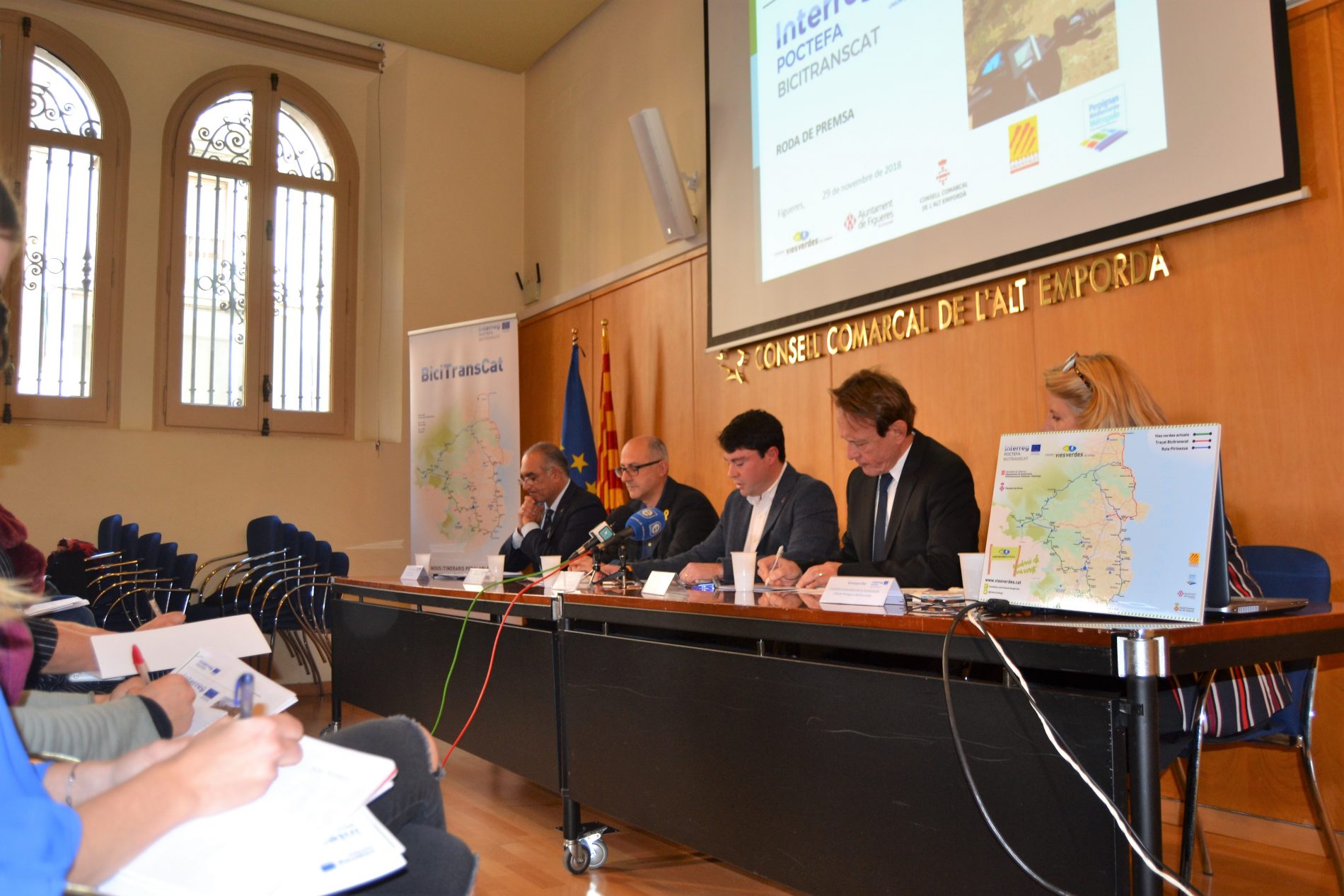
During the presenation, the Regional Councillor of Tourism, Joan Cano, explained that “the project presented today has its origins in the ENLLAÇ cross-border project, which resulted in the creation of the cyclable cross-border route known as PIRINEXUS. The success of this experience encouraged the partners to collaborate once again and to apply for European funding for POCTEFA cross-border projects during the 2014-2020 period. The BICITRANSCAT project to develop new cyclable routes and multimodal links was approved in 2017 and the different stages of the project are expected to be developed until the year 2020.”
He also added that BICITRANSCAT “responds to a need in the region to improve sustainable mobility options, while also offering a new infrastructure for the development of active and nature tourism. This kind of tourism has grown over recent years across the country and, at a regional level, we are lucky to have multiple resources to enable us to develop it. It is also very gratifying to be able to participate in a cross-border project that fosters relations with our neighbours and gives us the opportunity to work to develop both territories. Understanding the cross-border nature of the region as a tourist resource, understanding that this makes us stand out in a way which is different to other regions, should help give added value to the tourism on offer in the Alt Empordà. I’m convinced that the BICITRANSCAT project will help give it this added value, being built, at the same time, on a solid model of sustainable tourism.”
Five partners participate in the initiative: the Girona Greenways Consortium, leading the project, the Figueres City Council, the General Council of the Pyrénées-Orientales, the Perpignan Méditerranée Métropole, and the Alt Empordà Regional Council. The ultimate aim of the project is to link the tourist destinations of the province of Girona with those of the Pyrénées-Orientales Department, through a cycling network interconnected to different modes of public transport.
Albert Gómez, President of the Greenways Consortium, emphasised that “BICITRANSCAT is the continuation of another European project that enabled us to create the PIRINEXUS route in 2013. Today, this route is well-known across Europe, with its western side being part of the large Mediterranean European route known as Eurovelo 8. Pirinexus stands out for being an extensive circular route, taking in a variety of different landscapes. BICITRANSCAT will help to continue this consolidated model and to respond to the need to improve this proposal in the region of the Alt Empordà, also improving connectivity with French Catalonia. The proposal is not merely touristic, but also promotes sustainable mobility.”
Going on to explain specific aspects of the project, Gómez indicated that “the objective is to create a complementary route to the existing PIRINEXUS and EUROVELO 8 routes, from Castelló d’Empúries to Perpignan by the coast. This will enable a cross-border cyclable network which is connected to public transport, promoting sustainable mobility and providing a coastal route that offers an alternative to the roads that are often overcrowded during summer months. At this moment in time, we are working to complete the route, planning the final trajectory alongside the Parc del Cap de Creus and different town councils from the Alt Empordà (Figueres, Llancà, Port de la Sevla, Roses, Castelló d’Empúries), in order to find the most suitable stretches for the project. Once defined, the route will be adapted to the cycling network and the corresponding signage will be put up at each stage of it”.
The president of the Greenways Consortium added that “given the geography of the area and the existing stretches available, this cyclable route will be connected to different public transport options to enable connections with the main touristic destinations (Figueres, Llançà, Portbou, Perpignan) via bus and train lines. To be able to create this link with public transport, bike supports will be installed on buses and bike racks at the main bus and train stations. An application and a website will also be created to be able to consult the cyclable route, the existing bus and train stations on the route, as well as timetables for these services.
Francesc Cruanyes, Deputy Major of the City Council of Figueres, highlighted the “firm commitment of the city for this environmental, cross-border and transversal project. For us, this involves completing our cycling network as an element of sustainability and, at the same time, a tourist attraction. Robert Garrabe, Vicepresident of the General Council of the Pyrénées-Orientales, emphasised “the commitment of the Council to this project that will develop the territory touristically and economically in a sustainable way, while also creating jobs”. Representing the Perpignan Méditerranée Métropole, Véronique Oller also expressed “our satisfaction on being able to take an active part in this initiative which will help promote tourism in Perpignan and Figueres, as well as their respective outlying areas”.
During the presentation, the speakers also explained that the project will be presented at the main international and national hiking and cycling fairs to promote the new route and raise awareness of it. Next year the plan is to present it in Utrech, Touloussse and Stuttgart. In 2020, presentations will be made to the press and to tourist operators, and competions and instagrammer meetings will also be organised to promote the route among users and people who live in the area.
PROJECT FUNDING
To achieve all this, the “BICITRANSCAT” project has a budget of 4,689,269.25 euros, co-funded by the European Regional Development Fund (FEDER), through the Interreg V-A Spain-France-Andorra (POCTEFA 2014-2020) programme (65%), the Regional Council of Girona (25%), as associated member of the project, the self-funding of 10% by each Catalan partner, and 30-35% of self-funding from the French partners.
Budget breakdown by partner:
General Council of the Pyrénées-Orientales 1,431,500.00€
Perpignan Méditerranée Métropole 1,239,500.00€
City Council of Figueres 571,046.25€
Regional Council of Alt Empordà 269,477.00€
Girona Greenways Consortium 1,177,746.00€

- Details
- Written by: Vies Verdes Gi
- Category: News
- Hits: 0
On 17 August 2016, the European Commission approved version 2.2 of the INTERREG V-A Spain-France-Andorra Programme (POCTEFA 2014-2020).
The main objective of the Programme is to continue and reinforce the economic and social integration of the cross-border area through cooperation. Cooperation projects for eligible French, Spanish and Andorran partners across the territory are promoted and co-financed in order to achieve this goal. The INTERREG V-A Spain-France-Andorra Programme (POCTEFA 2014-2020) is funded by the European Union, with a total budget of 178 million euros from the European Regional Development Fund (FEDER without technical assistance).
On 4 November 2016, the POCTEFA Monitoring Committee approved the official text of the second call to tender of the INTERREG V-A Spain-France-Andorra Programme (POCTEFA 2014-2020).
On 31 May 2017, THE GIRONA GREENWAYS CONSORTIUM, along with its 4 partners,FIGUERES CITY COUNCIL, GENERAL COUNCIL OF THE PYRÉNÉES-ORIENTALES, L’ALT EMPORDÀ COUNTY COUNCIL and PERPIGNAN MÉDITERRANÉE MÉTROPOLE, presented the project “EFA 156/16 BICITRANSCAT” Development of new cyclable routes and cross-border multimodal links to promote sustainable mobility to the second call for POCTEFA projects.
The Programming Committee of POCTEFA 2014-2020, held on 8 November 2017 in Biarritz, approved the resolution of the second tender with 62 cross-border cooperation projects and 71 million euros of the European Regional Development Fund (FEDER). One of the projects approved was EFA 156/16 BICITRANSCAT.
The main objective of the BICITRANSCAT project is to develop a new coastal axis of cross-border sustainable mobility close to the EuroVelo 8 European cycling route, “The Mediterranean Route (Cadiz-Athens)”. This project thus meets the high expectations of cycle tourists, tourists with fixed abode, and the local population, already highlighted in the previous Link.
BICITRANSCAT aims to link the main tourist destinations of Girona and the Western Pyrenees via a cyclable route interconnected with public transport in different ways, thus promoting sustainable mobility and offering a coastal route which provides an alternative to the existing roads which are often congested during summer months.
To meet this goal, three large-scale tasks will be carried out:
– Construct a new stretch of the EuroVelo 8 route and improve it through the development of a network of greenways that will function as feeders to it, particularly from the TGV and AVE stations in Perpignan and Figueres, thereby improving the provision of existing sustainable cross-border transport.
– Develop new sustainable mobility services and facilitate multimodal cross-border cooperation (modes of acces, information, development of applications).
– Study user behaviour along these cross-border sustainable transport routes and measure the economic impact of the improvements on transport provision across the territory.
To achieve this, the “EFA 156/16 BICITRANSCAT” project has a budget of 4,689,269.25 euros, co-funded by the European Regional Development Fund (FEDER), through the Interreg V-A Spain-France-Andorra (POCTEFA 2014-2020) programme (65%), the Regional Council of Girona (25%), as associated member of the project, and the self-funding of 10% by the Girona Greenways Consortium.
- Details
- Written by: Vies Verdes Gi
- Category: News
- Hits: 0
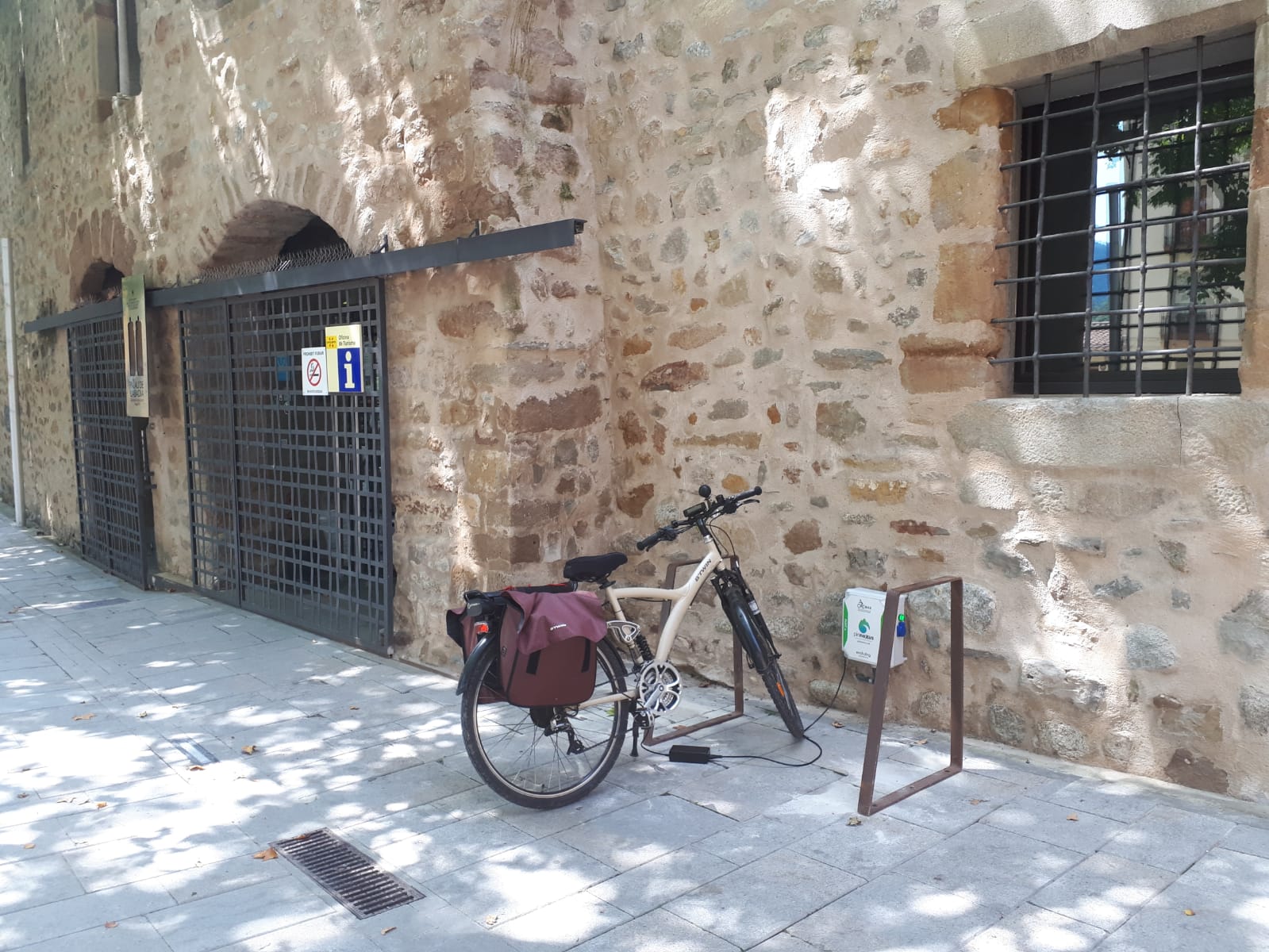
Over recent years we have seen a considerable rise in the use of electrically-assisted bikes, giving more people access to cyclable routes and making it necessary to provide access points where the bikes’ batteries can be charged. In view of this, this summer the Girona Greenways Consortium has completed the provision of eleven charging points located at different points along the Pirinexus route.
The cost of acquiring the eleven chargers has been 8,651.50 euros. The Consortium has bought the charging devices and has transferred their ownership to the municipalities in question free of charge. The city councils will be responsible for conserving and maintaining these devices during the transfer period, as well as bearing all costs for repairs and electricity consumption arising from their use. The ownership rights of the charging points will be valid for ten years, with the option to renew for five years more.
From this summer onwards, Girona Greenways and Pirinexus users will be able to charge their e-bikes in different municipalities and will be able to cover long distances without stopping.
- Details
- Written by: Vies Verdes Gi
- Category: News
- Hits: 0
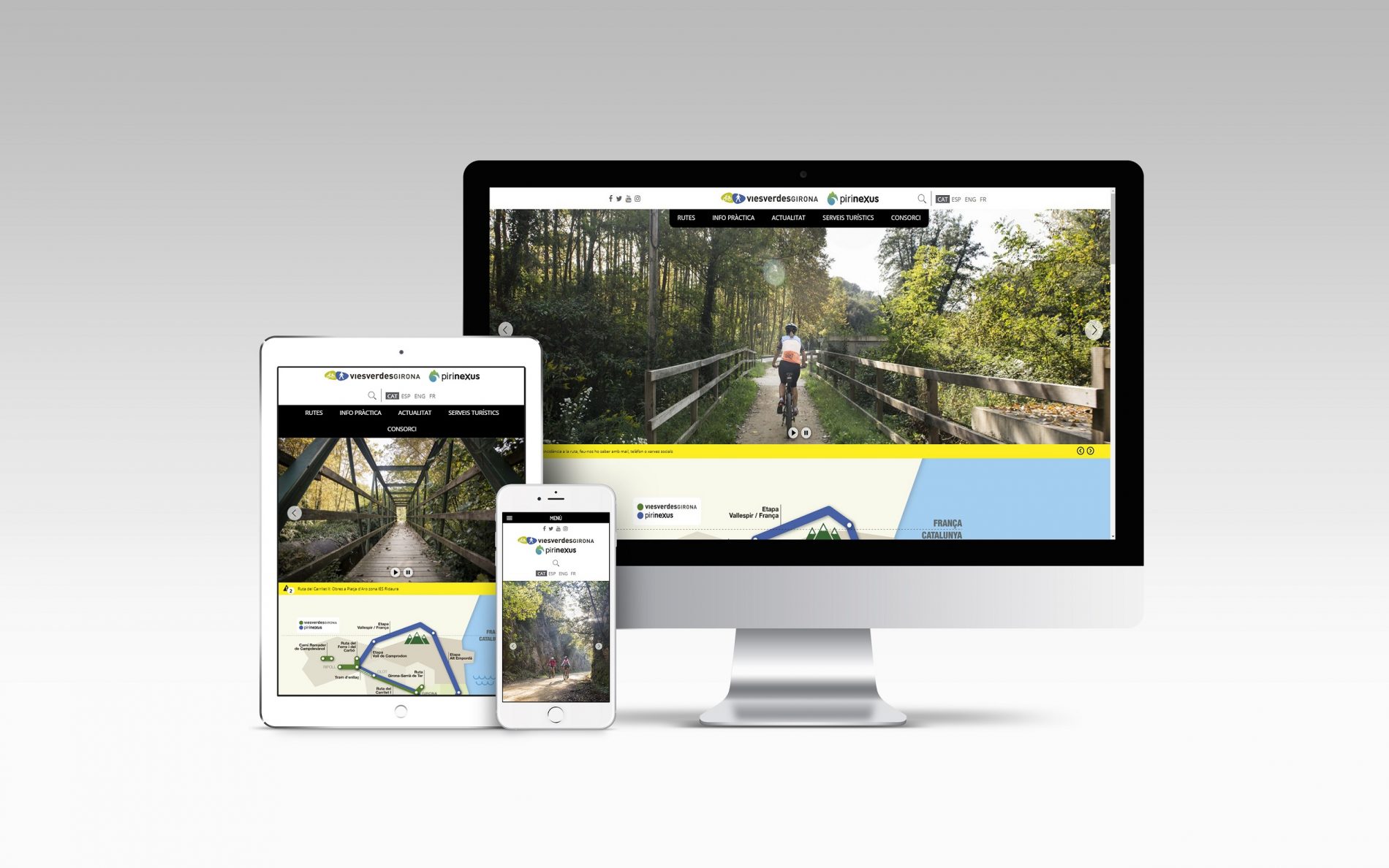
The www.viesverdes.cat website was created in 2006 and updated in 2012, while the Pirinexus route website, www.pirinexus.cat, has been operational since 2013. The Consortium has decided to integrate both websites into one, thereby avoiding the doubling up of information and helping to improve the way information is managed, as well as facilitating usability and user interaction, the classification of brands and the merging of web traffic.
Specific work has also been carried out to provide information on accessible stretches of the routes so that users who would like to plan an outing using an adapted bike, wheelchair, tandem or on foot with assistance can access detailed information about the options available to them.
The new format enables browsing from any kind of device or screen, from computers of all sizes to tablets or mobiles. The accessibility criteria applied also means that most of the information on the website can be browsed or read using a mouse, keyboard or Braille.
Information adapted to different groups
The new website has been designed taking into account the different groups to whom the Consortium information is addressed: users of the route, institutional users and the private sector. Information on routes is differentiated from institutional information in such a way that the tourist information (available in four languages) is separate from administrative information, while also complying with transparency requirements.
Alerts